
Bring every useful source together
Connect the advertising, commerce, CRM, analytics, payment, warehouse, and first-party data your team needs to see the whole business.
Foundry
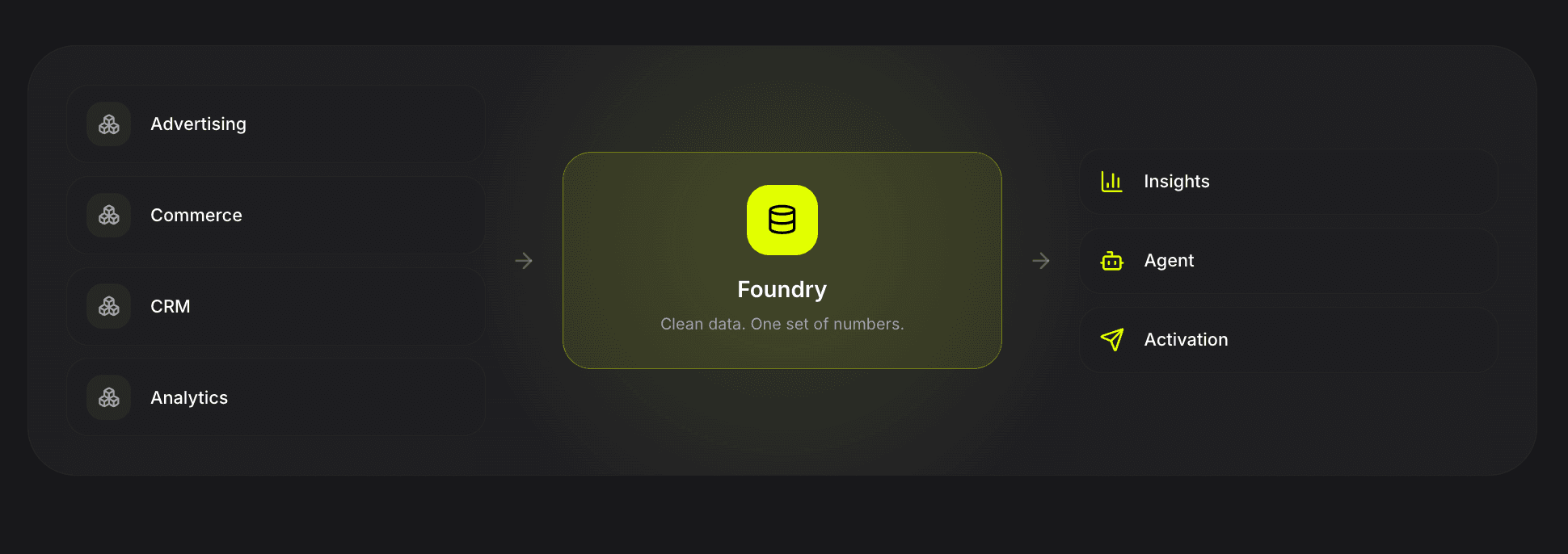
Foundry brings your customer, campaign, product, and revenue data together. It applies the same rules everywhere and catches problems before they reach a report, Agent, or marketing tool.










The foundation
Foundry handles the preparation and checks required before your team can trust a report, answer a question, or send data to another tool.
Connect the advertising, commerce, CRM, analytics, payment, warehouse, and first-party data your team needs to see the whole business.
Start quickly with Vendo-managed storage or connect your own warehouse when your team needs direct ownership and access.
Turn different source formats into consistent customers, campaigns, products, orders, revenue, and events that every team can use.
Catch late, missing, changed, duplicated, or unexpected data before it reaches a report, Agent answer, or marketing platform.
Agree how revenue, customers, channels, attribution, and customer groups are counted, then reuse the same meaning everywhere.
Inside the workspace
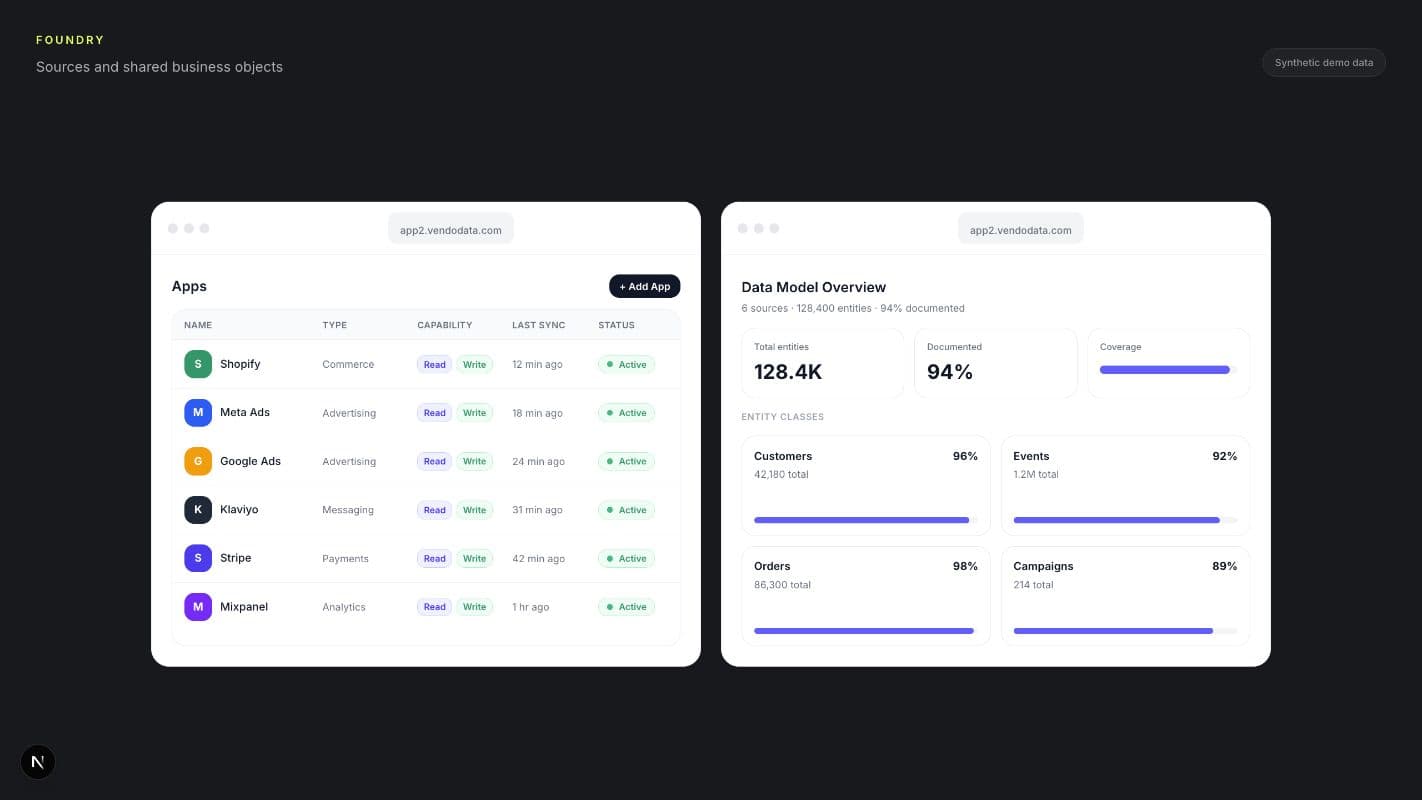
Connections and consistent customer, campaign, order, and revenue records stay visible together.
01 · Integrate
Use guided connectors for the tools you already run, collect first-party events, and keep a clear record of how data enters Foundry.
Connect advertising, analytics, commerce, CRM, payments, messaging, files, and databases.
Keep data fresh on a schedule and backfill history when the source supports it.
Collect browser and server events with campaign, click, session, and customer context.
See connection settings, past runs, failures, and the data each source contributes.
02 · Store
Start with Vendo-managed storage or connect your own BigQuery. Foundry keeps the preparation and business logic consistent across both approaches.
Get started without operating a warehouse. Vendo manages the storage and processing environment.
Fastest startConnect your BigQuery project when infrastructure ownership and direct warehouse access matter.
Bring your own03 · Model
Foundry turns different source formats into consistent customers, campaigns, orders, and revenue records. It then links customer identities and applies the rules your team uses to understand performance.
Link visits, signups, purchases, and CRM records that belong to the same customer, with the matching records visible.
Standardize customers, events, campaigns, products, orders, and revenue across source systems.
Set channel groupings, attribution methods, and lookback windows once for every downstream use.
Define CAC, ROAS, LTV, conversion metrics, and customer groups without rebuilding the logic.
04 · Validate
Foundry watches freshness, volume, structure, completeness, and business rules so broken inputs do not quietly become confident answers.
Detect late data, missing periods, unexpected drops, and unusual spikes.
Catch missing fields and structural changes before downstream models fail.
Apply built-in and custom expectations to the data your business relies on.
Review failures in Vendo and notify the right people when intervention is required.
Foundry health
Orders and revenue model
05 · Define
Agree how Vendo should count customers, channels, attribution, metrics, and customer groups. The same rules are then used in reports, Agent answers, and outgoing data.
Operational control
Foundry shows the rules behind your numbers, when sources last updated, customer matching issues, failed checks, run history, and whether data is ready to use.
Keep customers, campaigns, orders, fields, definitions, owners, and where the data is used easy to find.
Review when a source last updated and surface structural changes before they break downstream work.
Inspect the identifiers contributing to a customer and hold conflicting records for review instead of forcing a match.
Check uniqueness, required values, accepted categories, source separation, and reconciled counts.
See which job ran, what changed, whether it failed, and who owns the next step.
Review approved fields, mappings, exclusions, and staging results before prepared data is activated.
Built on Foundry
Foundry is the shared foundation beneath the rest of Vendo—not a separate data project your team has to maintain.
FAQ
Request Access
Bring the tools you use and one recurring data problem. We will explain what Vendo can handle, what setup is required, and any current limits.